
Since 2009
Since 2009



Arts & Science usually refers to a broad category of academic studies offered by colleges and universities. It combines subjects from the humanities, social sciences, natural sciences, and mathematics.
Arts focuses on human society, culture, language, and creative expression. Examples include:
History
Political Science
Economics
Psychology
Sociology
English Literature
Science focuses on understanding the natural world through observation, experimentation, and analysis. Examples include:
Physics
Chemistry
Biology
Mathematics
Computer Science
An Arts & Science college typically offers undergraduate and postgraduate degrees such as:
Bachelor of Arts (BA)
Bachelor of Science (BSc)
Master of Arts (MA)
Master of Science (MSc)
Wide variety of subjects and career options
Opportunities in teaching, research, business, government, media, technology, and more
Strong foundation for higher studies and competitive exams
If you're asking because you're choosing a college or course after school, I can also explain the difference between Arts, Science, Commerce, Engineering, and Arts & Science colleges.

B.Com is a course for students who want to build a career in accounting, finance, banking, business, or management.
📚 What do you study in B.Com?
Accounting
Business Management
Economics
Finance
Banking
Taxation
Business Law
Marketing
Financial Management
Computer Applications
🎓 Eligibility after 12th
Generally, you can study B.Com if:
✅ You have passed 12th / Higher Secondary
✅ Commerce students are commonly eligible
✅ Many colleges also accept Science and Arts students
✅ Some colleges may require Accountancy/Commerce as a subject
✅ Minimum marks vary by college, often around 40–50% or above
✅ Admission may be based on 12th marks or an entrance process, depending on the college
💼 Career options after B.Com
You can work in: Accounting • Banking • Finance • Taxation • Auditing • Insurance • Business Management
You can also continue with M.Com, MBA, CA, CMA, CS, or other professional courses after B.Com.
01.png)
B.Com C.A (Computer Applications) is a Bachelor of Commerce degree with a specialization in Computer Applications. It combines commerce/business studies with computer and information technology skills.
It is usually a 3-year undergraduate course (duration can vary by university) designed for students who want knowledge of both accounting/finance and computer applications.
Commerce subjects:
Financial Accounting
Cost Accounting
Management Accounting
Business Economics
Business Law
Banking and Finance
Taxation
Auditing
Computer Application subjects:
Programming fundamentals (such as C, C++, Java, or Python depending on the university)
Database Management Systems (DBMS)
Web Designing
Software Development basics
Computer Networks
Information Systems
E-commerce
Data Management
Accounting and financial management skills
Computer programming basics
Database handling
Business software knowledge
Data analysis skills
Understanding of IT systems used in companies
Graduates can work as:
Accountant
Financial Analyst
Tax Assistant
Banking professional
Computer Applications Executive
Business Analyst (entry level)
Software/IT support executive
Database assistant
E-commerce executive
Master of Commerce (M.Com)
Master of Computer Applications (MCA) (eligibility depends on university requirements)
Master of Business Administration (MBA)
Professional courses like Institute of Chartered Accountants of India (CA), CMA, or banking certifications
Educational qualification: Pass in 12th standard / Higher Secondary (10+2) from a recognized board.
Stream: Students from Commerce, Business Studies, or Accountancy backgrounds are usually preferred, but many colleges also accept students from Science or Arts streams.
Subjects: Having Accountancy, Mathematics, Computer Science, or Business Mathematics may be helpful (requirements vary by college).
Minimum marks: Often around 40–50% in 12th standard, depending on the college and university.
Admission: Usually through merit-based admission; some institutions may have their own entrance process.
01.png)
B.Com IT (Information Technology) is a Bachelor of Commerce degree with a specialization in Information Technology. It combines commerce/business studies with computer and IT skills, preparing students for careers that require knowledge of both finance and technology.
Accounting and Financial Management
Business Economics
Business Law
Taxation
Banking and Finance
Computer Fundamentals
Programming Languages (such as C, Java, Python, depending on the college)
Database Management Systems (DBMS)
Web Technology
Software Applications
E-commerce
Information Systems Management
Cybersecurity basics
Usually 3 years (6 semesters) in India.
Graduates can work in areas such as:
Accounting and finance with IT skills
Banking and financial services
Business analyst roles
IT support and administration
Database management
E-commerce management
Digital marketing
Software/IT service companies
ERP and business software support
After B.Com IT, students may pursue:
M.Com
MBA
MCA (if eligible)
CA (Chartered Accountancy)
CMA
PG Diploma in Data Analytics, Cybersecurity, or IT Management
Educational qualification: Pass 12th standard (Higher Secondary) from a recognized board.
01.png)
B.Com (Logistics & Supply Chain Management) is a specialized Bachelor of Commerce degree that combines core commerce subjects with the study of how goods and services move from suppliers to customers.
Along with regular B.Com subjects, you typically learn:
Financial Accounting
Business Economics
Marketing Management
Business Law
Logistics Management
Supply Chain Management
Inventory and Warehouse Management
Transportation and Distribution
International Trade
Procurement and Purchasing
Export and Import Management
Enterprise Resource Planning (ERP) basics
3 years (6 semesters) in most universities.
Inventory planning
Warehouse operations
Transportation management
Data analysis
Vendor and procurement management
Communication and problem-solving
Supply chain planning
After completing the degree, you can work as:
Supply Chain Executive
Logistics Coordinator
Warehouse Manager
Procurement Executive
Inventory Analyst
Operations Executive
Distribution Manager
Export–Import Executive
Demand Planner
E-commerce
Manufacturing
Retail
Shipping and logistics companies
FMCG
Pharmaceuticals
Automotive
Airlines and ports
You can pursue:
MBA in Supply Chain Management
MBA in Operations Management
M.Com
Professional certifications in logistics and supply chain
Generally, the eligibility criteria are:
Educational qualification: Must have completed 12th standard (Higher Secondary/Class 12) from a recognized board.
Stream: Students from Commerce, Science, or Arts streams can usually apply (requirements vary by college).
Minimum marks: Many colleges require around 45%–60% aggregate marks in Class 12 (varies by institution).
Subjects: Commerce students with Accountancy, Business Studies, Economics, or Mathematics may have an advantage, but it is not always compulsory.
01.png)
B.Com (Travel & Tourism) is a specialized Bachelor of Commerce undergraduate degree that combines core commerce subjects with the business and management aspects of the travel and tourism industry. It is typically a 3-year program (or 4 years under some universities' NEP structure).
The curriculum usually includes:
Financial Accounting
Business Economics
Business Law
Marketing Management
Human Resource Management
Travel and Tourism Management
Tourism Marketing
Airline and Airport Management
Hospitality Management
Tour Operations
Travel Agency Management
Entrepreneurship
Computer Applications in Business
Business and financial management
Customer service
Communication and interpersonal skills
Travel planning and tour management
Marketing and sales
Organizational and problem-solving skills
After completing B.Com (Travel & Tourism), you can work as:
Travel Consultant
Tour Manager
Travel Agency Executive
Airline Customer Service Executive
Tourism Officer
Event Coordinator
Hotel Operations Executive
Cruise Line Executive
Destination Manager
Tourism Marketing Executive
You can pursue:
MBA in Tourism or Hospitality Management
M.Com
MBA in Marketing or Finance
Postgraduate Diploma in Travel & Tourism
Certifications in airline ticketing, IATA, hospitality, or tourism management
Educational Qualification: Passed 10+2 (Higher Secondary/Class 12) from a recognized board.
Stream: Students from Commerce, Science, or Arts are usually eligible. Some colleges may prefer Commerce students, but it is not mandatory.
Minimum Marks: Typically 45%–50% aggregate marks in Class 12, though this varies by college and university.
Age Limit: Most colleges have no upper age limit, but you should check the specific institution's rules.
Admission Process: Admission is usually based on:
Merit (Class 12 marks), or
An entrance exam, depending on the university.
01.png)
B.Com (Banking Management) is an undergraduate Bachelor of Commerce degree that focuses on the banking, financial services, and business management sectors. It combines core commerce subjects with specialized knowledge of banking operations and financial management.
Typical subjects include:
Principles of Banking
Financial Accounting
Business Economics
Banking Laws and Regulations
Financial Management
Investment Management
Risk Management
Insurance
Taxation
Marketing Management
Business Statistics
Auditing
The exact curriculum varies by university.
3 years (6 semesters) in most Indian universities.
Graduates can work in:
Banks (public and private)
Insurance companies
Financial institutions
Investment firms
NBFCs (Non-Banking Financial Companies)
Corporate finance departments
Common job roles include:
Bank Officer
Relationship Manager
Credit Analyst
Financial Analyst
Loan Officer
Investment Associate
Insurance Advisor
Customer Service Executive
After B.Com (Banking Management), you can pursue:
M.Com
MBA (Finance or Banking)
CA (Chartered Accountancy)
CMA (Cost and Management Accountancy)
CS (Company Secretary)
CFA (Chartered Financial Analyst)
Professional banking certifications such as JAIIB and CAIIB
Educational Qualification: Pass in 10+2 (Higher Secondary) from a recognized board.
Minimum Marks: Usually 45–50% aggregate marks, though this varies by college and university.
Stream: Commerce students are commonly preferred, but many colleges also accept students from Science and Arts streams.
Age Limit: Generally, there is no specific age limit, though some institutions may have their own rules.
01.png)
B.Com (Professional) is an undergraduate commerce degree designed to combine the core subjects of a traditional Bachelor of Commerce (B.Com) with professional qualifications and industry-focused training. The exact curriculum varies by university.
Typically, the program includes:
Financial Accounting
Corporate Accounting
Business Law
Economics
Taxation
Auditing
Cost and Management Accounting
Financial Management
Business Analytics or Information Systems
In many colleges, B.Com (Professional) also integrates preparation for professional certifications such as:
Institute of Chartered Accountants of India (CA Foundation/Intermediate)
Institute of Company Secretaries of India (CS)
Institute of Cost Accountants of India (CMA)
Stronger focus on accounting, taxation, auditing, and finance than a regular B.Com.
Industry-oriented curriculum with practical projects, internships, and skill development.
Better preparation for professional exams and corporate careers.
Graduates can work as:
Accountant
Tax Consultant
Auditor
Financial Analyst
Banking Professional
Investment Analyst
Business Consultant
Finance Executive
Many students also pursue:
CA
CMA
CS
MBA
M.Com
| B.Com | B.Com (Professional) |
|---|---|
| General commerce degree | Commerce degree with professional specialization |
| Broader curriculum | Greater emphasis on accounting, taxation, auditing, and finance |
| Limited integration with professional courses | Often aligned with CA, CS, or CMA preparation |
| Suitable for general commerce careers | Better suited for finance, accounting, and professional certification pathways |
You must have passed 10+2 (Higher Secondary/Class 12) from a recognized board.
Most colleges require Commerce in Class 12, but many also accept students from Science and Arts, depending on their admission policy.
The minimum required marks are typically 45%–60% in Class 12, varying by institution.
Admission may be based on Class 12 merit or an entrance exam, depending on the college or university.
01.png)
B.Com (Aviation) is a specialized undergraduate degree that combines core commerce subjects with knowledge of the aviation industry. It is typically a 3-year bachelor's program (in countries like India) designed for students interested in business and management careers within aviation.
The curriculum usually includes:
Commerce subjects:
Financial Accounting
Business Economics
Business Law
Marketing
Human Resource Management
Taxation
Banking and Finance
Aviation-related subjects:
Aviation Management
Airline Operations
Airport Management
Aviation Safety and Security
Air Cargo and Logistics
Aviation Regulations
Customer Service in Aviation
Graduates can pursue roles such as:
Airport Operations Executive
Airline Customer Service Executive
Cargo and Logistics Coordinator
Ground Staff Supervisor
Aviation Sales and Marketing Executive
Travel and Tourism Executive
Aviation HR or Finance Executive
Potential employers include airlines, airports, logistics companies, travel companies, and aviation service providers.
After B.Com (Aviation), you can pursue:
MBA (Aviation Management)
MBA (Finance, Marketing, HR, Operations)
M.Com
Professional certifications in logistics, aviation management, or finance
B.Com (Aviation) is a good fit if you:
Enjoy commerce and business studies.
Want to work in the aviation or airport sector.
Are interested in management, finance, logistics, or customer service rather than becoming a pilot or aircraft engineer.
| B.Com | B.Com (Aviation) |
|---|---|
| Focuses on general commerce and business | Combines commerce with aviation industry knowledge |
| Suitable for careers across many industries | Tailored toward aviation, airports, airlines, and logistics |
| Broader career options | Includes both general commerce careers and aviation-specific roles |
A B.Com (Aviation) degree does not qualify you to become a pilot or aircraft maintenance engineer. Those careers require separate aviation training and licensing. Instead, this degree prepares you for business, management, operations, finance, and administrative roles in the aviation industry.
Educational qualification: Pass in 10+2 (Class 12) from a recognized board.
Stream: Students from Commerce, Science, or Arts are usually eligible. Commerce is not always mandatory.
Minimum marks: Typically 45–50% aggregate, though this varies by college. Some institutions may require higher marks.
Age limit: Most colleges do not have a strict age limit, but individual institutions may have their own policies.
Admission process: Many colleges admit students based on Class 12 marks, while some may conduct an entrance test or interview.
01.png)
A B.Com (Hons) stands for Bachelor of Commerce (Honours). It is an undergraduate degree in commerce and business that usually takes 3 to 4 years, depending on the country and university.
The "(Hons)" or "Honours" designation means the program is more specialized and academically rigorous than a regular B.Com. It typically includes:
Advanced courses in accounting, finance, economics, taxation, and business management.
More in-depth study of commerce subjects.
Research projects, dissertations, or additional electives in some universities.
Higher academic standards and often stricter admission requirements.
Financial Accounting
Corporate Accounting
Business Economics
Financial Management
Taxation
Auditing
Business Law
Marketing
Human Resource Management
Statistics
Business Mathematics
After completing a B.Com (Hons), graduates can work as:
Accountant
Financial Analyst
Tax Consultant
Auditor
Banking Professional
Investment Analyst
Business Consultant
Marketing Executive
They can also pursue higher studies such as:
MBA (Master of Business Administration)
M.Com (Master of Commerce)
Professional qualifications like CA (Chartered Accountant), CMA (Cost and Management Accountant), CS (Company Secretary), or CFA (Chartered Financial Analyst).
| B.Com | B.Com (Hons) |
|---|---|
| Covers commerce subjects broadly | Provides deeper specialization in commerce |
| Generally less intensive | More academically rigorous |
| Fewer advanced or research-based courses | Includes advanced and sometimes research-oriented coursework |
| Suitable for general commerce careers | Preferred for specialized careers and higher studies |
Educational qualification: Passed Class 12 (Higher Secondary) from a recognized board.
Stream preference: Usually students from the Commerce stream are preferred, but many universities also accept students from Science or Arts streams.
Subjects required: Often requires Commerce/Accountancy as a subject, though some universities allow admission without it.
Minimum marks: Commonly around 50%–60% aggregate marks in Class 12 (varies by college and category).
Admission process: May be through merit-based admission or an entrance exam such as Common University Entrance Test (CUET-UG) for participating universities.

BBA stands for Bachelor of Business Administration. It is an undergraduate degree program that focuses on the fundamentals of business, management, and administration.
A BBA course usually covers subjects such as:
Business Management
Marketing
Finance
Human Resource Management
Accounting
Entrepreneurship
Business communication
Operations management
Duration: Usually 3 years (in many countries, including India), though some programs may follow a 4-year structure.
Career options after BBA:
Business analyst
Marketing executive
Sales manager
Human resources specialist
Financial analyst
Operations manager
Entrepreneur
Many BBA graduates also pursue a postgraduate degree such as Master of Business Administration (MBA) to improve career opportunities.
In simple terms: BBA teaches you how businesses work and prepares you for management and business-related careers.
Education: Passed Class 12 (10+2) from a recognized board.
Stream: Students from Commerce, Science, or Arts streams can generally apply.
Minimum marks: Often around 45%–60% in Class 12 (varies by college).
Age: Many colleges accept students who are around 17–25 years old, though rules differ.
Entrance exam: Some universities require an entrance test, while others offer admission based on Class 12 marks.
01.png)
BBA (Finance) stands for Bachelor of Business Administration in Finance. It is a 3-year undergraduate degree (in many countries, including India) that focuses on business management with a specialization in financial planning, investment, banking, and corporate finance.
Common subjects include:
Financial Accounting
Corporate Finance
Investment Management
Banking and Insurance
Financial Markets
Taxation
Business Economics
Statistics and Business Mathematics
Risk Management
Financial Analysis
Management Principles
Marketing and Human Resource Management
A BBA (Finance) helps you build skills in:
Managing money and investments
Analyzing financial statements
Understanding stock markets and financial products
Budgeting and financial planning
Business decision-making
Using financial tools and software
Graduates can work as:
Financial Analyst
Investment Analyst
Banking Associate
Credit Analyst
Financial Advisor
Relationship Manager
Accounts Executive
Insurance Consultant
Corporate Finance Associate
You can also pursue higher studies such as:
Master of Business Administration (MBA) in Finance
Chartered Accountancy (CA)
Chartered Financial Analyst (CFA)
Financial certifications in banking, investment, or risk management
The general eligibility criteria are:
Educational qualification: Passed 10+2 (Class 12) or equivalent from a recognized board.
Stream: Students from Commerce, Science, or Arts streams can usually apply (requirements vary by college).
Minimum marks: Commonly around 50%–60% aggregate marks in Class 12 (may vary by institution).
Subjects: Some colleges prefer or require Mathematics/Business Mathematics/Statistics as a subject, especially for finance specialization.
Age limit: Usually there is no strict age limit, but some institutions may have their own rules.
Entrance exams: Some universities admit students through entrance tests, while others offer admission based on Class 12 marks.
01.png)
BBA (Marketing) stands for Bachelor of Business Administration in Marketing. It is an undergraduate degree program that focuses on business management along with the principles and practices of marketing.
During a BBA (Marketing) course, students learn how companies understand customers, promote products/services, build brands, and increase sales.
Marketing Management
Consumer Behaviour
Market Research
Digital Marketing
Advertising and Brand Management
Sales Management
Business Communication
Financial Accounting
Human Resource Management
Business Economics
Entrepreneurship
E-commerce
Communication and presentation skills
Sales and negotiation skills
Market analysis
Branding strategies
Digital marketing skills
Business decision-making
Graduates can work as:
Marketing Executive
Digital Marketing Specialist
Brand Manager (with experience)
Sales Manager
Market Research Analyst
Social Media Manager
Business Development Executive
Advertising Executive
Many students pursue:
Master of Business Administration (MBA) with a specialization in Marketing
Professional certifications in digital marketing, analytics, or sales
Usually 3 years (in India), though some universities may structure it differently.
BBA (Marketing) is a good choice for students interested in business, creativity, communication, customer psychology, advertising, and sales strategies.
Educational qualification: Passed Class 12 (10+2) from a recognized board in any stream (Commerce, Science, or Arts).
Minimum marks: Usually around 45%–60% aggregate marks (varies by college/university).
Subjects: Some colleges may prefer or require Mathematics/Business Studies/Economics, but many accept students without Mathematics.
Age limit: Some institutions may have an age requirement depending on their rules.
Admission process: Admission may be based on Class 12 marks or an entrance exam conducted by the university.
01.png)
BBA (Retail) stands for Bachelor of Business Administration in Retail. It is an undergraduate degree program focused on the business and management aspects of the retail industry—the sector involved in selling products and services directly to customers.
The course usually covers areas such as:
Retail management – planning and managing retail stores and operations
Sales and marketing – customer behavior, advertising, promotions, and sales strategies
Supply chain and inventory management – sourcing, storage, and movement of products
Retail finance – budgeting, pricing, and financial management
Store operations – merchandising, store layout, and customer service
E-commerce and digital retail – online stores and modern retail technologies
Human resource management – managing retail employees and teams
Duration: Usually 3 years (6 semesters) after completing 12th grade.
Career opportunities after BBA (Retail):
Retail Store Manager
Retail Operations Executive
Sales Manager
Brand Manager
Merchandising Executive
Customer Relationship Manager
E-commerce Executive
Supply Chain Coordinator
Graduates can work with retail companies, shopping malls, supermarkets, fashion brands, consumer goods companies, and online marketplaces. They can also pursue higher studies such as an MBA in Retail Management, Marketing, or Business Administration.
Educational qualification: Passed Class 12 (10+2) from a recognized board in any stream (Commerce, Science, or Arts).
Minimum marks: Commonly around 45%–60% aggregate marks (varies by college and university).
Age requirement: Some institutions may have age limits, but many do not.
Entrance exam: Some colleges admit students through merit, while others may require an entrance test or interview.
01.png)
BBA HRM is a three-year undergraduate degree in human resource management. This programme combines the study of management techniques along with specialised and expert training in Human Resource and Personnel Management.
01.png)
BBA (Tourism) stands for Bachelor of Business Administration in Tourism. It is an undergraduate degree program that combines business management principles with the tourism and travel industry.
The course teaches students how to manage and operate businesses related to tourism, such as travel agencies, hotels, airlines, tour companies, resorts, and tourism organizations.
Tourism Management
Travel Agency and Tour Operations
Hospitality Management
Hotel and Resort Management
Tourism Marketing
Business Communication
Accounting and Finance Basics
Human Resource Management
Event Management
Sustainable Tourism
Airline and Airport Management
Usually 3 years (6 semesters) after completing 12th grade.
Graduates can work as:
Travel Consultant
Tour Manager
Tourism Officer
Airline Ground Staff Manager
Hotel/Resort Manager
Event Coordinator
Destination Manager
Travel Operations Executive
Customer Relationship Manager
✅ Educational qualification: Passed Class 12 (10+2) from a recognized board.
01.png)
Business Analytics (BA) in a Bachelor of Business Administration (BBA) program is an undergraduate degree specialization that combines business management skills with data analysis and technology. It teaches students how to use data to understand business performance, solve problems, and make better decisions.
A BBA in Business Analytics usually covers:
Business fundamentals
Accounting
Finance
Marketing
Management
Operations
Data and analytics skills
Statistics
Data visualization
Database management
Business intelligence
Predictive analytics
Data-driven decision-making
Technology tools
Microsoft Power BI
Tableau
Microsoft Excel (advanced)
SQL
Basic programming (often Python)
Career options include:
Business Analyst
Data Analyst
Marketing Analyst
Financial Analyst
Operations Analyst
Business Intelligence Analyst
Consultant
Product Analyst
Graduates can work in industries such as:
Banking and finance
Technology
E-commerce
Healthcare
Retail
Consulting
A student typically learns to:
Analyze company data and trends
Create reports and dashboards
Identify business opportunities
Forecast future outcomes
Support management decisions using data
| Regular BBA | BBA Business Analytics |
|---|---|
| Focuses mainly on management | Combines management + data skills |
| Less technical | More technology and statistics |
| General business roles | Business + analytics roles |
| Suitable for broad management careers | Suitable for data-driven business careers |
Eligibility for a BBA (Business Analytics) program generally depends on the university, but common requirements are:
Educational qualification: Must have completed 12th standard (Class 12 / Higher Secondary) from a recognized board.
Stream: Students from Commerce, Science, or Arts streams can usually apply.
Minimum marks: Often around 50%–60% aggregate marks (varies by college).
Subjects: Mathematics/Statistics may be preferred or required in some colleges, but many institutions accept students without Mathematics.
01.png)
Bachelor of Business Administration in Computer Applications (BBA CA) is an undergraduate degree that combines business management with computer and IT skills. It is designed for students who want to understand how businesses operate while also learning how technology supports modern organizations.
The course usually includes subjects such as:
Business and Management
Principles of Management
Accounting and Finance
Marketing Management
Human Resource Management
Business Communication
Entrepreneurship
Computer and IT
Programming languages (such as C, C++, Java, or Python depending on the college)
Database Management Systems
Web Development
Software Engineering
Computer Networks
Information Systems
Usually 3 years (6 semesters) after completing 12th grade.
Graduates can work in roles such as:
Software or Application Support Executive
Business Analyst
Database Administrator (entry level)
Web Developer
IT Project Coordinator
Digital Marketing Executive
System Administrator
Management Trainee
You can also continue studies with:
Master of Business Administration (MBA)
Master of Computer Applications (MCA)
Specialized courses in data analytics, cybersecurity, cloud computing, or software development
✅ Educational qualification: Pass 12th standard (Higher Secondary) from a recognized board.
✅ Stream: Students from Commerce, Science, or Arts streams are generally eligible. Some colleges may prefer students who studied Mathematics or Computer Science, but it is not always compulsory.
✅ Minimum marks: Many colleges require around 40–50% marks in 12th (varies by institution).
✅ Admission: Some colleges offer admission based on 12th marks, while others may conduct an entrance test.
01.png)
A Bachelor of Business Administration (BBA) in International Business is an undergraduate degree that focuses on how businesses operate across countries and global markets. It combines core business knowledge with an understanding of international trade, global economics, cross-cultural management, and international marketing.
Typical subjects include:
Principles of Management
Marketing
Finance and Accounting
Human Resource Management
International Business Environment
International Marketing
International Trade and Export-Import Management
Global Supply Chain and Logistics
International Economics
Business Law
Cross-Cultural Communication
Foreign Language (offered by some universities)
During the course, you'll learn to:
Understand global business strategies.
Analyze international markets.
Manage cross-cultural teams.
Negotiate with international clients.
Handle import-export operations.
Solve business problems in a global context.
Graduates can work in roles such as:
International Business Executive
Export-Import Manager
International Marketing Executive
Supply Chain Analyst
Business Development Executive
Global Procurement Officer
Foreign Trade Analyst
International Sales Manager
Industries include:
Multinational companies (MNCs)
Banks and financial institutions
Logistics and shipping companies
Export-import firms
Consulting firms
E-commerce companies
After a BBA in International Business, you can pursue:
MBA in International Business
MBA in Marketing
MBA in Finance
Master's in Economics or Management
Professional certifications in supply chain, logistics, or international trade
A BBA in International Business is a good option if you:
Want to work for multinational companies.
Are interested in global trade and international markets.
Enjoy learning about different cultures and economies.
Plan to build a career in export-import, international marketing, or global management.
.
Educational qualification: Pass 10+2 (Class 12) from a recognized board (CBSE, ISC, State Board, etc.). (Careers360)
Minimum marks: Usually 50% aggregate for General category. Some universities require 55–60%, while reserved categories may receive relaxation according to the institution's rules. (Careers360)
Stream: Students from Commerce, Science, or Arts/Humanities are generally eligible. Some universities may prefer or require subjects such as Mathematics, Commerce, or English. (BMU)
Entrance exam: Admission may be:
Merit-based (based on Class 12 marks), or
Through entrance exams such as UGAT, CUET, or the university's own entrance test, depending on the college. (Careers360)
01.png)
The Bachelor of Business Administration (BBA) in Entrepreneurship program is designed to prepare future entrepreneurs with the skills and knowledge to start their own businesses.This specialization equips you to start your own company. The students learn all about establishing a company from the ground up, the laws and compliances one has to follow to do the same. This is ideal for students who want to join and grow their family businesses or want to start their own business.
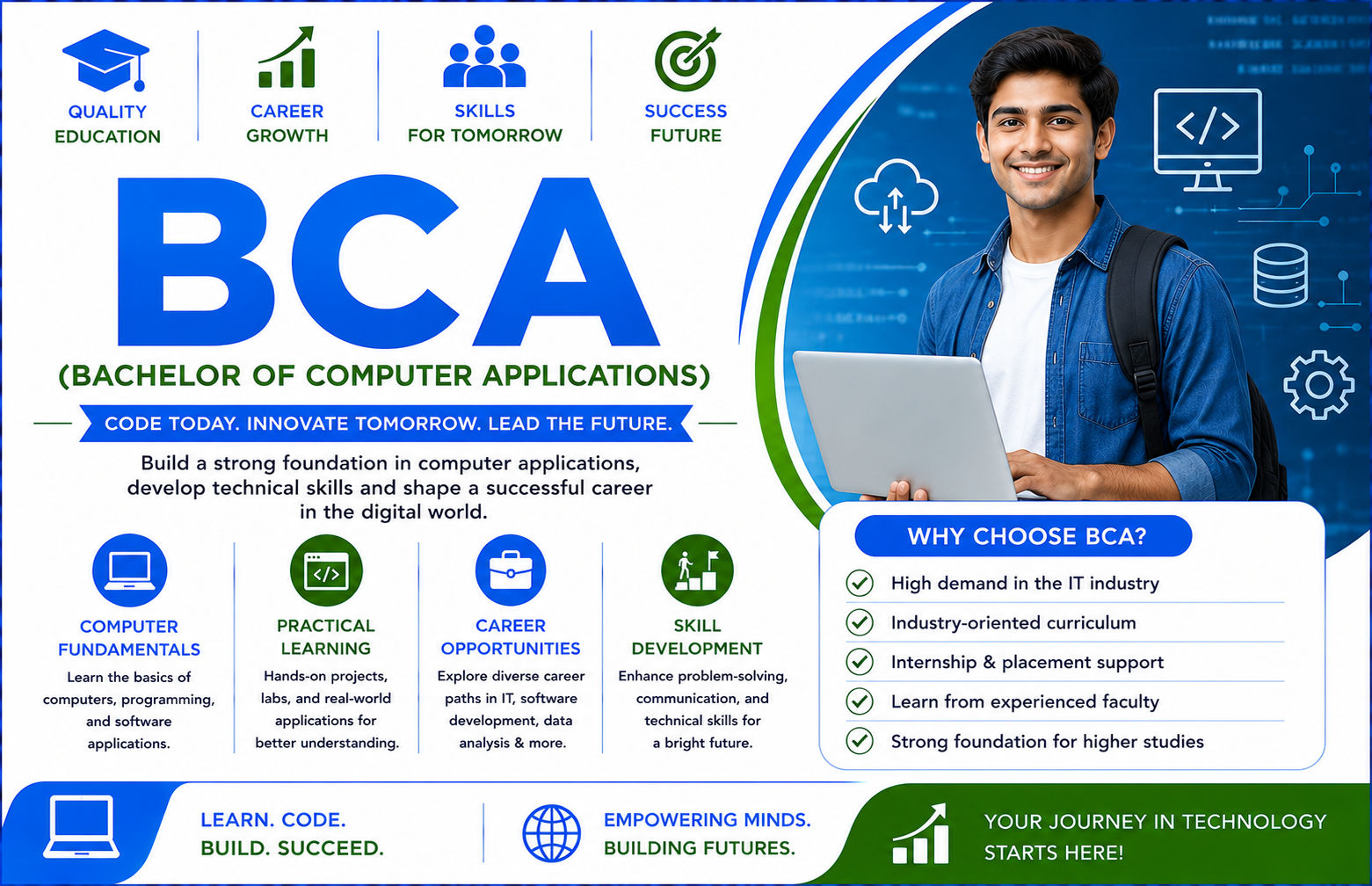
BCA most commonly stands for Bachelor of Computer Applications, an undergraduate degree focused on computer science, software development, and information technology.
Typically, the program:
Lasts 3 years (6 semesters) in countries like India.
Covers programming, databases, networking, web development, operating systems, and software engineering.
Is suitable for students interested in careers in software and IT.
Common subjects include:
Programming in C, C++, Java, or Python
Data Structures
Database Management Systems (DBMS)
Computer Networks
Operating Systems
Web Development
Software Engineering
Cloud Computing and Cybersecurity (in some curricula)
After a BCA, graduates often:
Work as software developers, web developers, system administrators, database administrators, QA engineers, or IT support specialists.
Pursue higher studies such as an Master of Computer Applications (MCA), an MBA, or specialized certifications in fields like cloud computing, AI, or cybersecurity.
Depending on the context, BCA can also mean other things, such as:
Board of Control for Cricket in India (more commonly abbreviated as BCCI, not BCA)
Bank of Central Asia
Behavioral and Cognitive Analysis
If you meant BCA in the context of college admissions or careers, it almost certainly refers to Bachelor of Computer Applications.
You must have completed 10+2 (Class 12) or an equivalent qualification from a recognized board.
Most colleges require a minimum of 45–50% marks, though some prestigious institutions may have higher cutoffs.
Many colleges accept students from any stream (Science, Commerce, or Arts).
Some universities require Mathematics or Computer Science as a subject in Class 12, while others do not.
Admission may be based on Class 12 marks or through an entrance exam, depending on the institution.
01.png)
BCA (Data Analytics) is a specialization of the Bachelor of Computer Applications (BCA) that focuses on using computer technology, programming, and statistical methods to collect, analyze, and interpret data. It prepares students for careers in data-driven fields.
A typical BCA (Data Analytics) program includes subjects such as:
Programming (Python, Java, C++)
Database Management (SQL)
Statistics and Probability
Data Visualization (e.g., Tableau, Power BI)
Machine Learning fundamentals
Data Mining
Big Data concepts
Cloud Computing
Artificial Intelligence basics
Business Analytics
Web Technologies
Data cleaning and preparation
Data analysis using Python and SQL
Creating dashboards and reports
Statistical analysis
Data visualization
Problem-solving and critical thinking
Basic machine learning
After completing BCA (Data Analytics), you can work as:
Data Analyst
Business Analyst
Junior Data Scientist
BI (Business Intelligence) Analyst
Data Visualization Specialist
SQL Developer
Reporting Analyst
Data Engineer (entry-level, with additional skills)
You can continue with:
Master of Computer Applications (MCA)
Master of Business Administration (MBA) (Business Analytics)
Master of Science (M.Sc.) in Data Science
Professional certifications in data analytics, cloud computing, or AI
BCA (Data Analytics) is a good choice if you:
Enjoy working with numbers and data.
Like programming and technology.
Want to solve business problems using data.
Are interested in AI, machine learning, or business intelligence.
Most colleges require:
Completion of 10+2 (or equivalent) from a recognized board.
Some institutions require Mathematics or Computer Science in high school, while others accept students from any stream.
Overall, BCA (Data Analytics) combines computer application skills with modern data analysis techniques, making it a strong option for students interested in careers in technology and analytics. Demand for data analytics professionals continues to grow across industries such as finance, healthcare, e-commerce, manufacturing, and IT.
01.png)
BCA (Web Designing) usually refers to a specialization or focus within a Bachelor of Computer Applications program that emphasizes building and designing websites.
In this course, students typically learn:
HTML – Creates the structure of web pages.
CSS – Styles web pages with colors, fonts, and layouts.
JavaScript – Adds interactivity, such as buttons, forms, and animations.
Responsive Web Design – Makes websites work well on phones, tablets, and desktops.
UI/UX Basics – Designing websites that are attractive and easy to use.
Graphics & Multimedia – Using tools like Adobe Photoshop or Figma for web layouts.
Web Hosting & Domains – Publishing websites online.
Basic Databases & Backend – Introduction to technologies like MySQL and server-side programming.
Designing professional websites
Creating responsive web pages
Basic front-end development
Understanding user experience (UX)
Working with web development tools
After completing BCA with a web designing focus, you can work as:
Web Designer
Front-End Developer
UI Designer
UX Designer
Website Administrator
Freelance Web Developer
BCA is a broad computer applications degree covering programming, databases, networking, software development, and more.
BCA (Web Designing) gives additional emphasis to website design and front-end web development while still covering core BCA subjects.
You must have passed 10+2 (Class 12) or an equivalent examination from a recognized board.
Most colleges require 45%–50% minimum marks in Class 12 (the exact requirement varies by institution).
Students from Science, Commerce, or Arts streams are usually eligible.
Some colleges prefer or require Mathematics or Computer Science in Class 12, but many do not.
Some universities admit students based on Class 12 marks, while others conduct an entrance exam.
01.png)
BCA (Artificial Intelligence) is a specialized undergraduate degree called Bachelor of Computer Applications (Artificial Intelligence). It combines core computer science with artificial intelligence, machine learning, and data-driven technologies.
Typical subjects include:
Computer Programming (Python, Java, C++)
Data Structures and Algorithms
Database Management Systems (DBMS)
Operating Systems
Computer Networks
Artificial Intelligence fundamentals
Machine Learning
Deep Learning
Data Science
Natural Language Processing (NLP)
Computer Vision
Cloud Computing
Cybersecurity
Mathematics and Statistics for AI
Programming and software development
AI model building
Data analysis and visualization
Problem-solving and logical thinking
Machine learning techniques
Working with AI tools and frameworks
After completing BCA (AI), you can work as:
AI Engineer
Machine Learning Engineer
Data Analyst
Data Scientist (often with additional study or experience)
Software Developer
Business Intelligence Analyst
AI Research Assistant
Python Developer
Automation Engineer
You can continue with:
BCA → Master of Computer Applications (MCA)
BCA → Master of Science in Artificial Intelligence (M.Sc. AI)
BCA → Master of Technology (M.Tech) (if eligible)
Specialized AI, Machine Learning, or Data Science certifications
3 years (6 semesters) in most universities.
It can be a strong option if you enjoy:
Coding
Mathematics and logical reasoning
Solving real-world problems
Working with AI technologies such as chatbots, recommendation systems, and image recognition
As AI adoption continues to grow across industries, graduates with AI-related skills are in demand. Building a strong portfolio through projects, internships, and programming practice during the degree can significantly improve career prospects.
Educational qualification: Pass 10+2 (Class 12) from a recognized board.
01.png)
BCA (Cloud Computing) is a specialization in the Bachelor of Computer Applications (BCA) program that focuses on Cloud Computing technologies. It teaches students how to build, deploy, manage, and secure applications and data on cloud platforms instead of traditional on-premises servers.
Typical subjects include:
Computer Programming (C, Java, Python)
Data Structures
Database Management Systems (DBMS)
Operating Systems
Computer Networks
Cloud Computing Fundamentals
Virtualization
Cloud Security
Web Development
DevOps basics
Big Data and Internet of Things (in some colleges)
Amazon Web Services (AWS)
Microsoft Azure
Google Cloud Platform (GCP)
Deploying applications on the cloud
Managing virtual machines and containers
Cloud storage and networking
Basic cybersecurity
Scripting and automation
Database administration
Troubleshooting cloud infrastructure
After completing BCA (Cloud Computing), you can work as:
Cloud Support Engineer
Cloud Administrator
Cloud Engineer
DevOps Engineer (entry level)
System Administrator
Technical Support Engineer
Software Developer
You can continue with:
Master of Computer Applications (MCA) (MCA)
Master of Business Administration (IT or Systems)
Cloud certifications such as AWS Certified Cloud Practitioner, Microsoft Azure Fundamentals, or Google Cloud Digital Leader
You must have passed 10+2 (PUC/Class 12) from a recognized board.
Most colleges accept students from any stream (Science, Commerce, or Arts).
Many colleges require a minimum of 45–50% marks in Class 12 (the exact requirement varies).
Some universities may require Mathematics or Computer Science in Class 12, but many do not.
A few institutions conduct an entrance exam, while many offer admission based on Class 12 marks.
01.png)
BCA (Cyber Security) stands for Bachelor of Computer Applications in Cyber Security. It is an undergraduate degree that combines core computer application subjects with specialized training in protecting computer systems, networks, and data from cyber threats.
Typically, the course lasts 3 to 4 years, depending on the university and country.
Common subjects include:
Computer Programming (C, C++, Java, Python)
Data Structures
Database Management Systems
Computer Networks
Operating Systems
Ethical Hacking
Network Security
Cryptography
Cyber Forensics
Cloud Security
Web Application Security
Digital Laws and Cyber Law
Identifying and preventing cyber attacks
Securing computer networks
Ethical hacking and penetration testing
Digital forensics and incident response
Risk assessment and security auditing
Secure software development
After completing a BCA in Cyber Security, you can work as:
Cyber Security Analyst
Ethical Hacker (Penetration Tester)
Information Security Analyst
Security Operations Center (SOC) Analyst
Network Security Engineer
Digital Forensics Analyst
Security Consultant
Incident Response Analyst
You can continue with:
MCA
M.Sc. Cyber Security
MBA (IT or Information Systems)
Industry certifications such as Certified Ethical Hacker (CEH), CompTIA Security+, Certified Information Systems Security Professional (CISSP) (typically after gaining experience), or CompTIA CySA+.
The eligibility for BCA (Cyber Security) depends on the university, but the common requirements are:
Educational qualification: Pass in 10+2 (PUC/Class 12) from a recognized board.
Minimum marks: Usually 45%–50% aggregate (some colleges require higher, while some have no minimum beyond passing).
Stream: Many colleges accept students from Science, Commerce, or Arts. Some prefer or require Mathematics or Computer Science at the 10+2 level, but this is not universal.
Entrance exam: Some universities admit students based on Class 12 marks, while others conduct their own entrance test or accept scores from a state-level entrance exam.
01.png)
A BSc (Computer Science), or Bachelor of Science in Computer Science, is an undergraduate degree that focuses on the theory, design, development, and application of computers and software. It typically takes 3 years to complete in countries like India.
Common subjects include:
Programming languages (such as C, C++, Java, or Python)
Data Structures and Algorithms
Database Management Systems (DBMS)
Operating Systems
Computer Networks
Software Engineering
Web Development
Artificial Intelligence (in some universities)
Cybersecurity basics
Cloud Computing (in some curricula)
Programming and software development
Problem-solving and logical thinking
Database design and management
Website and application development
Basic networking and cybersecurity
Teamwork and project management
After completing a BSc (Computer Science), you can work as:
Software Developer
Web Developer
Mobile App Developer
Data Analyst
System Administrator
Database Administrator
Technical Support Engineer
QA/Test Engineer
IT Support Specialist
In most Indian universities:
Completion of 10+2 (PUC/Class 12) from a recognized board.
Many colleges require Mathematics or Computer Science at the 10+2 level, though requirements vary by institution.
01.jpg)
BSc (Information Technology) is a 3-year undergraduate degree program focused on computer systems, software, data, and how information is stored, processed, and managed using technology.
In simple terms, it teaches you how computers and digital systems work in real-world applications—especially in software development, databases, networking, and IT services.
You typically learn subjects like:
Programming (C, C++, Java, Python)
Database Management Systems (DBMS)
Computer Networks
Web Development
Operating Systems
Software Engineering
Cybersecurity basics
Data Structures and Algorithms
Coding and software development
Problem-solving and logical thinking
Working with databases and networks
Basic IT system management
After graduating, you can work in roles such as:
Software Developer / Programmer
Web Developer
System Administrator
Database Administrator
IT Support / Technical Support Engineer
Cybersecurity Analyst (entry-level)
Eligibility can vary slightly by college, but generally it is:
You must have completed 12th (PUC or equivalent) from a recognized board
Minimum marks: usually 45%–60% (depends on college)
01.png)
BSc (Mathematics) stands for Bachelor of Science in Mathematics.
It is an undergraduate degree program focused on the study of mathematics as a core scientific subject.
You learn both pure and applied mathematics, such as:
Algebra (equations, groups, matrices)
Calculus (differentiation and integration)
Geometry and Trigonometry
Differential Equations
Probability and Statistics
Numerical Methods
Linear Algebra
Logical reasoning and problem-solving
Analytical thinking
Mathematical modeling
Data interpretation
Usually 3 years in India (and many other countries)
This course is ideal if you:
Enjoy solving math problems
Like logical thinking and patterns
Are interested in careers in data, teaching, research, or finance
You can go into:
Data Analyst / Data Science (with further study)
Banking and Finance
Actuarial Science
In India (and most colleges), the eligibility is usually:
1. Educational qualification
You must have completed Class 12 (PUC / Higher Secondary)
2. Required subjects
Mathematics is compulsory in Class 12
Other subjects can be Physics, Chemistry, Computer Science, or Statistics (varies by college)
3. Minimum marks
Generally 40%–60% aggregate marks in Class 12
(Exact cutoff depends on the college/university)
4. Stream
Mostly students from Science stream are eligible
Some universities may also allow Commerce students if they studied Mathematics
5. Age limit
Usually no strict age limit (depends on institution)
01.png)
BSc (Fashion Designing) is a Bachelor of Science undergraduate degree focused on learning how clothing, accessories, and fashion products are designed, developed, and produced.
You learn both creative + technical skills, such as:
Fashion illustration (sketching designs)
Textile science (fabrics and materials)
Pattern making and garment construction
Fashion history and trends
Computer-aided design (CAD) for fashion
Draping and tailoring techniques
Merchandising and fashion marketing
Usually 3 years (some colleges may vary slightly)
Students who completed 12th grade (any stream, usually Arts/Commerce/Science)
Some institutes may require entrance tests or portfolio submission
Creativity and design sense
Knowledge of fabrics and stitching
Trend forecasting
Branding and fashion business basics
You can work as:
Fashion designer
Textile designer
Costume designer (films, TV, theatre)
Fashion stylist
Merchandiser
Fashion illustrator
Boutique owner or entrepreneur
To join a BSc Fashion Designing course, you generally need:
1. Educational qualification
You must have passed Class 12 (10+2) from a recognized board
Any stream is usually accepted:
Arts ✔️
Commerce ✔️
Science ✔️
2. Minimum marks
Most colleges require around 45%–60% marks in 12th
Some top institutes may require higher scores
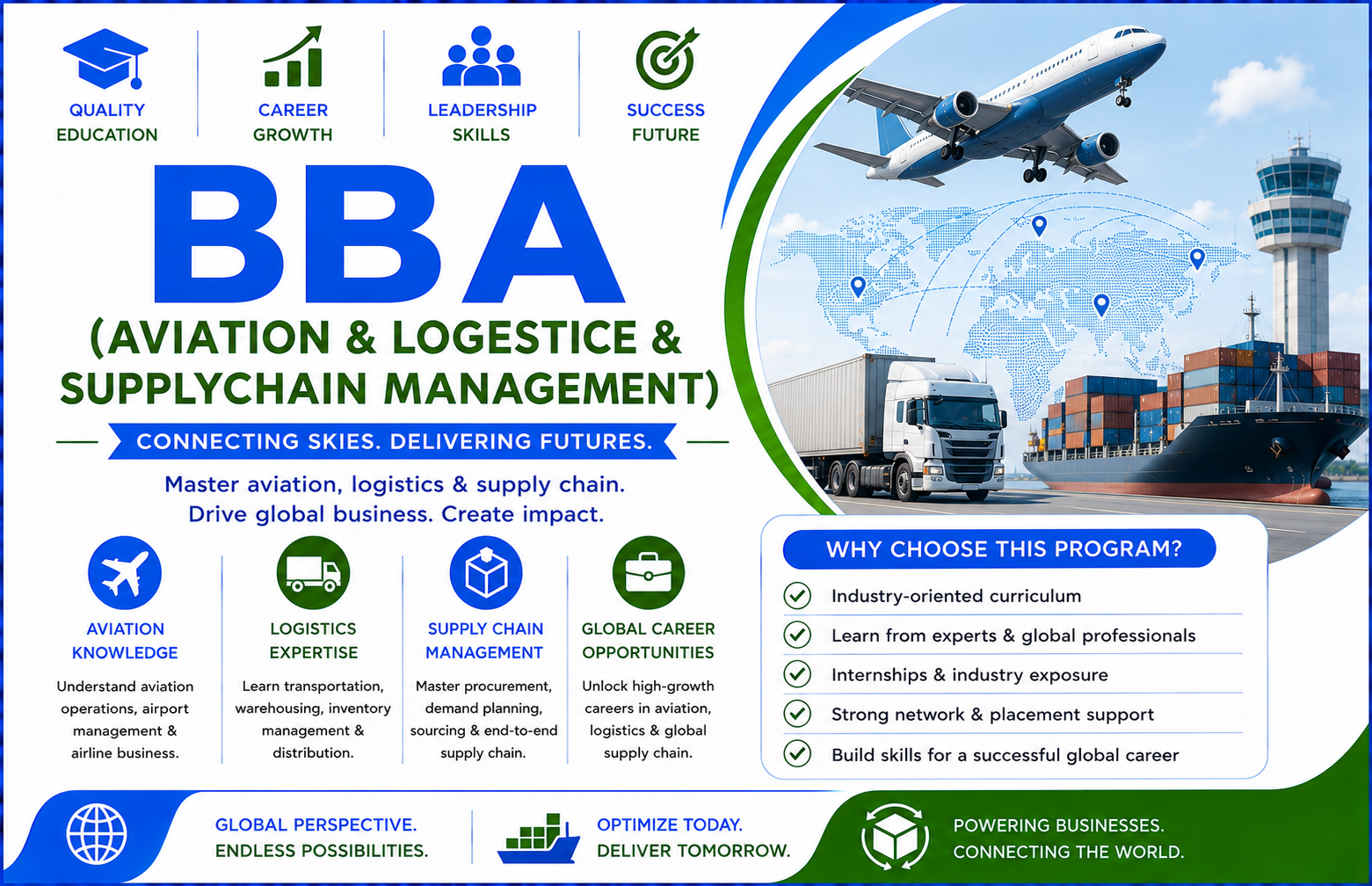
BBA Aviation & Logistics and Supply Management is a specialized undergraduate business degree (usually 3 years) that combines business administration with the aviation industry and global supply chain operations.
Here’s a simple breakdown:
This part focuses on the airline and aviation industry, such as:
Airline management
Airport operations
Air traffic basics (not pilot training)
Aviation safety and regulations
Customer service in airlines
Ground handling and airport logistics
This focuses on how goods are stored, transported, and delivered globally, such as:
Supply chain management
Warehousing
Transportation management (road, air, sea)
Inventory control
Import-export operations
Distribution systems
After completing this degree, you can work as:
Airport operations executive
Ground staff supervisor
Logistics coordinator
Supply chain analyst
Cargo manager
Airline customer service manager
Export-import executive
To join this course in India, you generally need:
You must have completed 10+2 (Class 12) from a recognized board
Any stream is usually accepted:
Science
Commerce
Arts
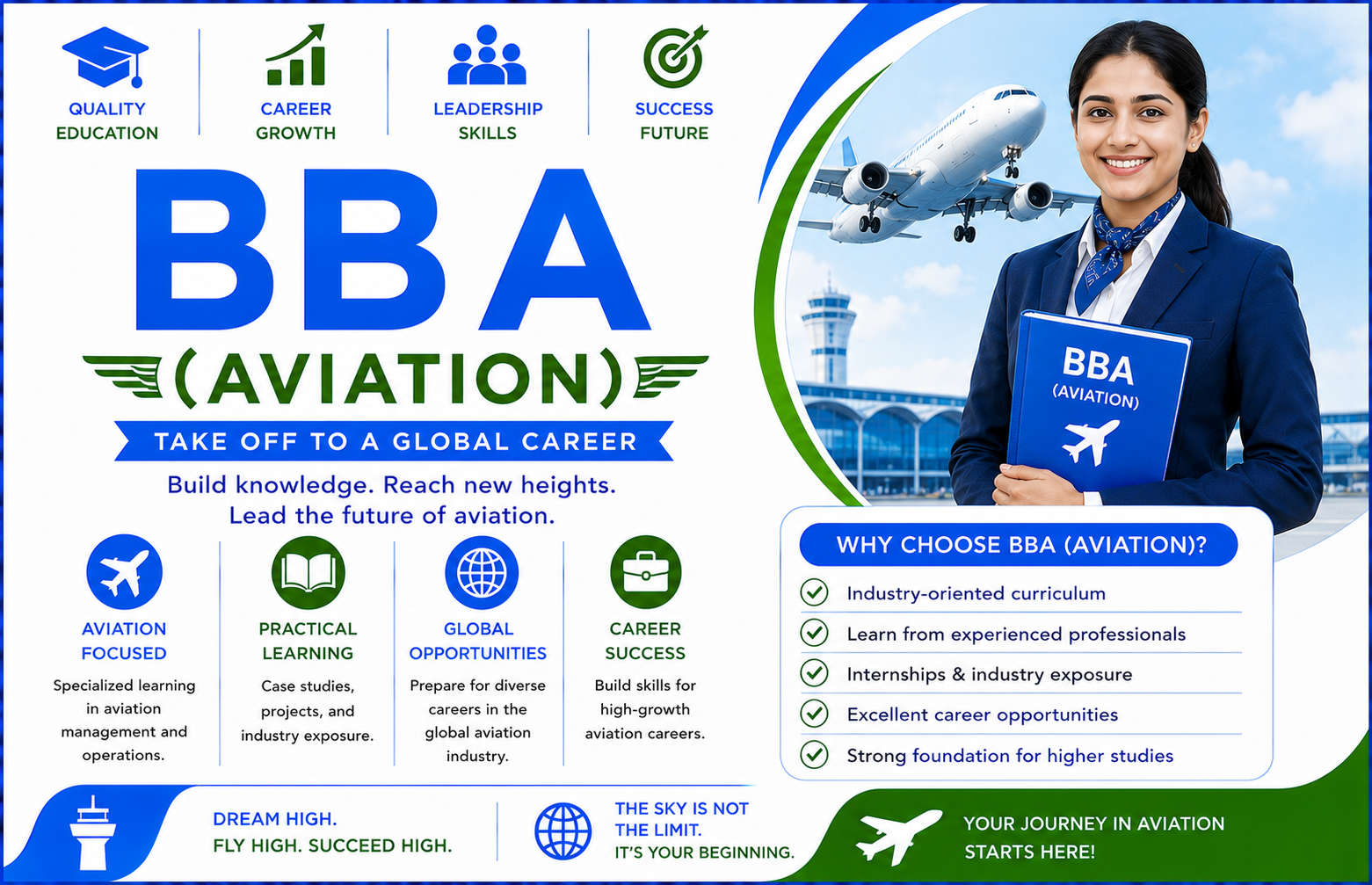
A BBA Aviation course is an undergraduate degree program called Bachelor of Business Administration in Aviation. It combines business management studies with aviation industry knowledge.
This course teaches how the aviation industry works along with management skills, such as:
Airline and airport management
Aviation safety and operations
Air ticketing and reservation systems
Cargo and logistics management
Customer service in aviation
Business, marketing, and finance basics
It is designed to prepare students for managerial and administrative roles in the aviation sector, not for becoming a pilot.
Usually 3 years (6 semesters)
After completing BBA Aviation, you can work in:
Airlines (IndiGo, Air India, etc.)
Airports (operations, customer service, ground handling)
Cargo and logistics companies
Travel and tourism companies
Aviation consultancy firms
Job roles include:
Airport Manager
Ground Staff Supervisor
Cargo Manager
Airline Operations Executive
Ticketing and Reservation Agent
To join a BBA Aviation course, the basic eligibility is usually:
Education: You must have completed 10+2 (Class 12) from a recognized board
Stream: Any stream is accepted (Arts, Commerce, or Science) in most colleges
Minimum marks: Usually 45% to 60% aggregate (varies by college)
Age limit: Generally 17 to 25 years (some colleges may not strictly enforce this)
English requirement: Many colleges prefer good basic English communication skills









Your Future is Created by what you do Today not Tomorrow
UDYAM REGISTRATION NUMBER : UDYAM-TN-03-0125460
© Bright Life All Rights Reserved
