
Since 2009
Since 2009


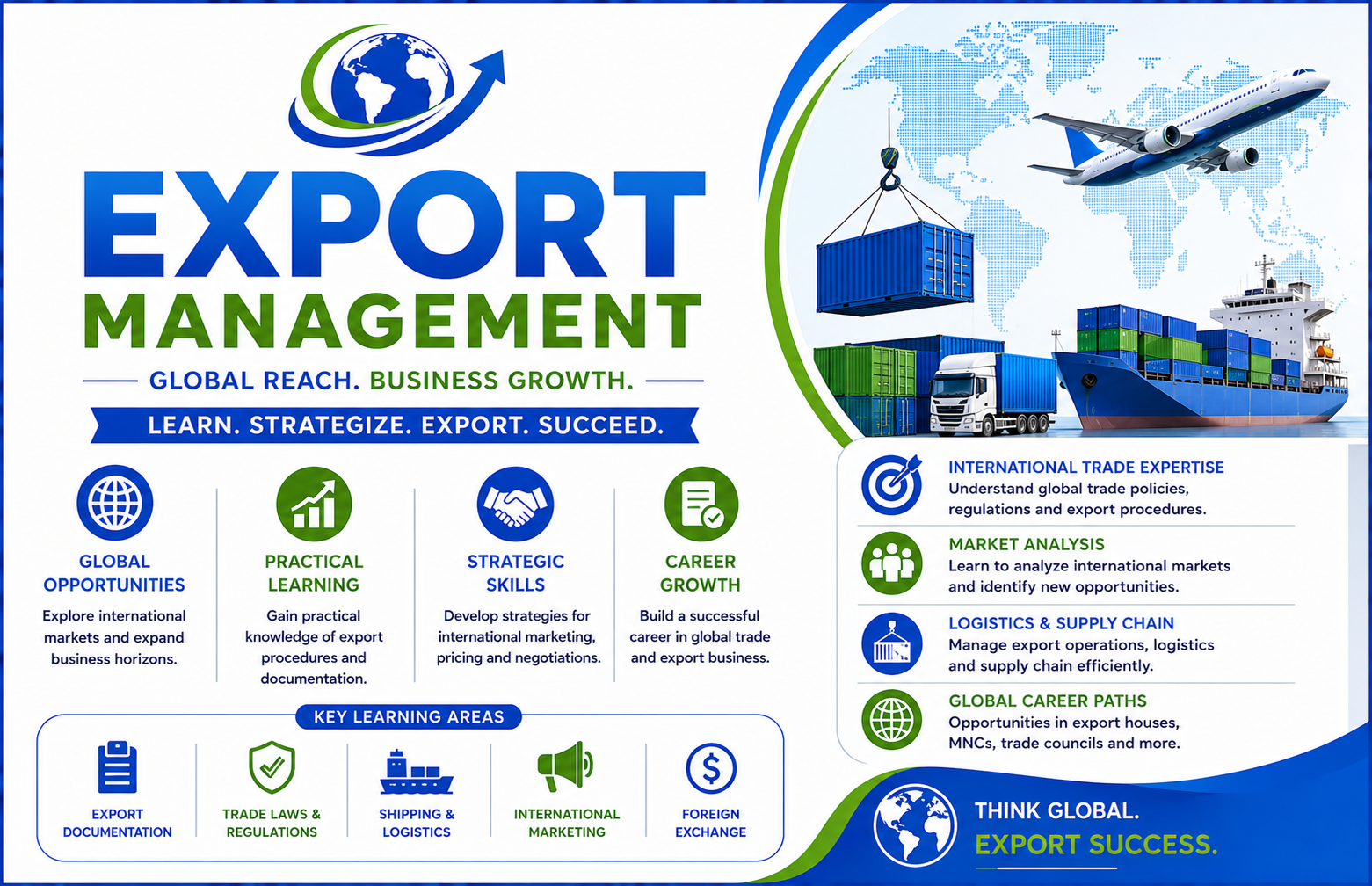
An Export Management course is a business and trade-focused program that teaches how goods and services are sold and shipped from one country to another.
In simple terms, it trains you to handle the entire process of international selling (exporting)—from finding foreign buyers to making sure products legally and safely reach another country.
1. Basics of International Trade
How global trade works
Import vs export rules
Trade policies and agreements
2. Export Documentation
Invoices, packing lists, shipping bills
Customs paperwork
Certificates of origin and compliance
3. Logistics & Shipping
Sea, air, and land transport
Freight forwarding
Warehousing and supply chain basics
4. International Marketing
Finding overseas customers
Market research for different countries
Pricing for global markets
5. Foreign Exchange & Payments
Currency exchange systems
International payment methods (LC, bank transfer, etc.)
6. Export Laws & Regulations
Customs duties
Trade restrictions
Compliance with international rules
Export Manager
International Trade Consultant
Logistics Coordinator
Import-Export Executive
Supply Chain Analyst
Eligibility for an Export Management course depends on the level of the course (certificate, diploma, or degree), but generally the requirements are simple.
1. Educational Qualification
Most courses require 10+2 (12th pass) from any stream (Arts, Commerce, or Science)
For advanced courses (Diploma/PG), you may need:
Bachelor’s degree in any discipline
2. Minimum Marks
Usually no strict cut-off, but some institutes prefer 40–50% or above
3. Age Limit
Generally no fixed age limit
Some short-term programs prefer candidates 18 years or older
4. Language Skills
Basic English communication is helpful (important for international trade)
5. Additional Advantage (not mandatory)
Background in commerce, business, or economics
Interest in international trade or logistics









Your Future is Created by what you do Today not Tomorrow
UDYAM REGISTRATION NUMBER : UDYAM-TN-03-0125460
© Bright Life All Rights Reserved
